

Once when I was in the first grade, we were playing a game called Cowboys and Cowgirls during recess. I don’t remember the rules of the game, or if we ever played it before or after this particular day — but I do know we were taking turns being horses, too, and if you were a horse, someone would ride you and say Giddyup! or Whoa! as you crawled around the industrial carpet on all fours.
We were in our classroom which was on the basement level of our tiny elementary school on the Upper West Side in New York City. It was wintertime, and too cold to go to the park that day.
We had eaten lunch at our desks, and our teacher, Mrs. B, had gone up to the Teachers’ Kitchen to have her own lunch. She’d left us with the directive to keep the volume down — which now strikes me as a hopeful thing to say to twenty six-year-olds you’re about to leave on their own.
I was scared of Mrs. B. At the parent-teacher conference she’d told my mother that I “gesticulated too much.” This sounded like a terrible thing to do and I told my mom she must have confused me with someone else.
“It means you use your hands a lot,” my mother said. “You put your finger on your chin when you’re thinking, or wave your hands around when you talk.”
My mother’s side of the family is Italian. As far as I could tell, everyone used their hands when they were talking. I was a shy kid, and had become more so since my grandmother died and my parents got divorced a couple of years before I started first grade. I took the rules seriously, always did my homework, never talked out of turn.
After the parent-teacher conference I’d sit on my hands when I spoke in class. I didn’t raise my hand anymore even when I knew the answer, because I wasn’t sure if that was part of “gesticulating” — and I didn’t like speaking in front of the whole room, anyway.
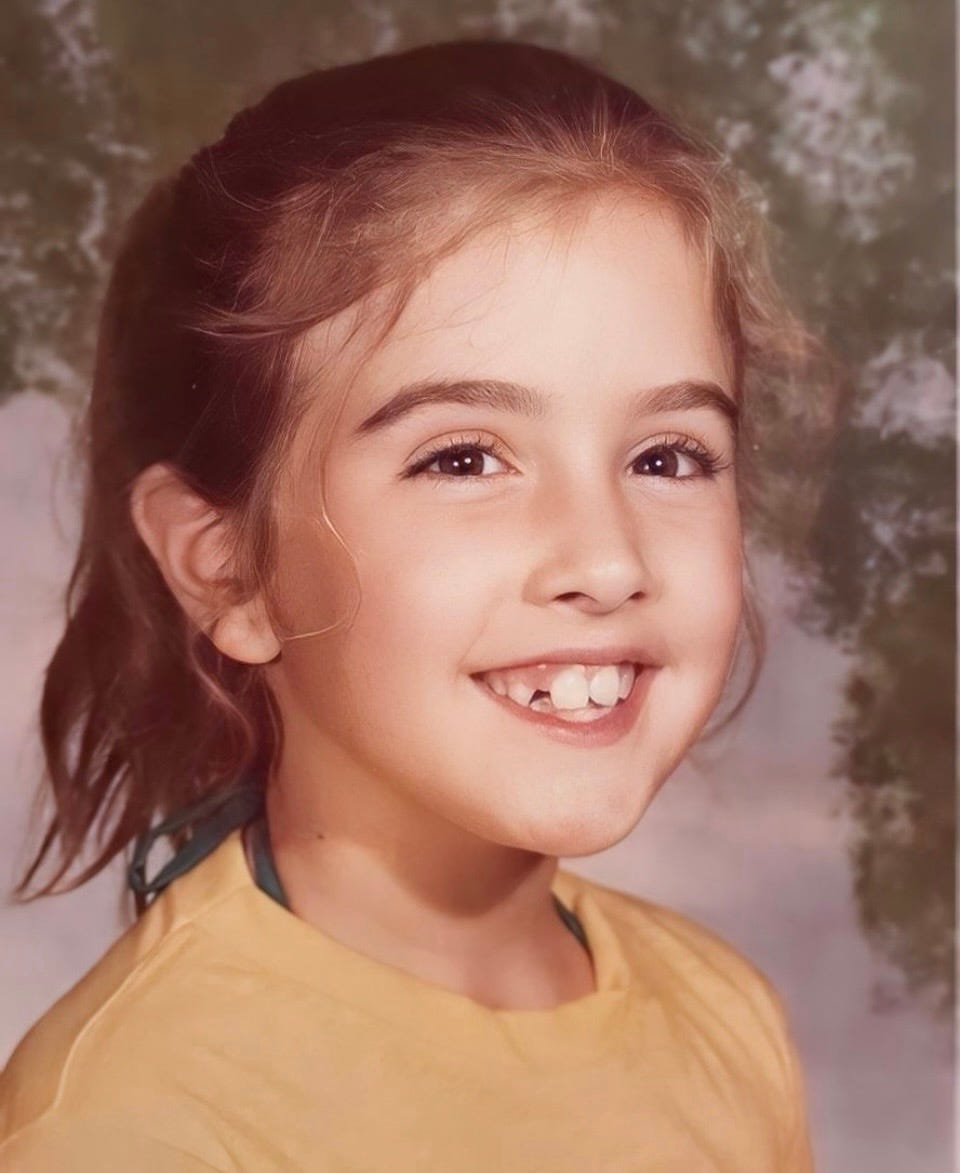
Things were not great at home. I had two homes at that point, even though my mom would say my home was with her and I just visited my dad. Whatever you called it, I was at my dad’s half the time, and I missed my mom so much I cried myself to sleep most nights. I couldn’t tell my dad I missed her, or ask to call her on the phone, because he’d get this look on his face like I’d hurt him, badly.
He talked to me all the time about his problems, and he’d cry, which was scary for me. I’d hug him and say comforting things to try to make him feel better. He’d take me to meet all his lady friends and then remind me it was “our secret” on the way home to my stepmom, who wasn’t my stepmom yet. It was a lot to manage.
My not-yet stepmom didn’t like it if I missed my mom, either. I had to act like I was okay, or everyone would get upset, which was a very different thing than actually being okay, which I was not.
When I’d get to my mom’s house, she’d be tired from working all day, but she went on dates most of the nights I was there, which made me very sad. I didn’t understand why she couldn’t stay home with me more of the time, but she’d get angry if I asked her and then the night would be ruined, anyway. If she did stay home, we’d have dinner at the diner on the corner, and then she’d fall asleep watching something on tv.
School was the place where I felt secure, like things made sense. I had good friends at school, and on the day in question, we had been alone for about twenty minutes playing our game. I’m sure we got louder by the minute. I know all the horses were laughing, and some of them started trying to buck us off. I don’t remember who decided it would be fun to play Cowgirls and Cowboys, but I know it wasn’t me.
I didn’t really understand the games my friends liked to play, but I would always try to join in. My head was filled with grown-up worries, things like whether my dad would be okay while I was at my mom’s, or if he’d have no one to talk to if a woman called the house and my not-yet-stepmom cried in the bathroom all night.
I wanted to be a normal kid and do normal kid things.
That’s why I was riding a horse-friend and yelling “Giddyup, let’s gooooo!” — feeling surprised by how much fun I was having — when Mrs. B came down the stairs and into our classroom. Everyone in the room was either playing a horse, riding a horse, or being bucked off of a horse. There were peals of laughter and probably a lot of noise, and then — horribly — there was Mrs. B, bellowing, “Ally! Get over here! RIGHT. NOW.”
The room froze, and my friends Jenny and Jessie looked at me with wide, sympathetic eyes. I got off my horse quickly and walked over to Mrs. B with my face on fire and my heart pounding so loudly I was sure the whole room could hear it.
She told everyone to get in their seats and not to say a word until she was back. Then she turned and glared at me. “Come with me,” she said, and started marching up the stairs. I looked up at her in front of me, climbing the stairs. Cream-colored cardigan, dark skirt and tights, and what my mother would call “sensible shoes” — but she’d say it like she smelled something bad.
“Did I do something wrong?” My voice sounded eight octaves higher than usual because I was terrified.
“You’re getting the children into too much trouble,” she said. That sentence reverberated inside my head — there was something wrong with it, and my six-year-old mind tried to work out what it was. We got to the top of the stairs, and she told me to sit on the bench outside the principal’s office, which was also within view of the Teachers’ Kitchen. I wanted to disappear.
This is where the bad kids sat when they got in trouble, and I could not understand what I’d done. I hadn’t done anything any of the other kids weren’t doing, so why was I on the bench where all the older kids in school would see me, and all the other teachers, too? Now everyone was going to think I was a bad kid, when I tried so hard to be good all the time.
The year before, when I was in Kindergarten, the teachers lost me six times in one school year because I was always daydreaming. I’d get caught up staring at a caterpillar on Caterpillar Rock in Riverside Park, and not realize my entire class was gone until I looked up and found I was alone. Or we’d be walking as a group back to school, and I’d see ivy growing thick up the side of an entire building, and wonder where the roots were, at the bottom or the top … and how long it had taken for the ivy to grow up or down all the floors of the building that way. By the time I’d thought about all that, I’d look around and see I was on a corner by myself.
It’s lucky that every time they lost me, there was a compassionate stranger around to help me find my way back to school. My mom told me this year I had to make sure that didn’t happen. I had to pay attention when we were out at the park or on a field trip, she didn’t want to get a single phone call that I’d gotten lost. So far I hadn’t gotten lost at all. I might not be perfect, but I was doing the best I could.
And what did she mean, I was “getting the children into too much trouble”? Wasn’t I one of the children? Could she tell I was different, that my head was full of grown-up things? I didn’t know if she was going to bring me into the principal’s office, or if she’d already talked to him, and he was going to come out and get me — but the thought of it was too much and I could feel a lump rising in my throat, and tears welling up in my eyes. I could see a blurry Mrs. B sitting at the table in the kitchen, drinking coffee and talking to the second grade teacher, Mrs.D, who would likely remember me as the bad kid on the bench when I started in her class next year.
That wasn’t the worst of it, though. The principal of our school was a wonderful old man (he was probably at least fifty) with a twinkle in his eye, Mr. Spence, and he and Mrs. Spence ran the school together. They were loving and warm, and the kind of people you never wanted to disappoint. They’d come to our school Assembly together every Friday. I thought they’d been married for a hundred years. I wondered if Mrs. Spence was in the inner office, too, and if I would have to go and face them together. I didn’t think I could take that.
I started to gasp for breath. A tear slipped down my cheek, and then another, and I wiped them away with the backs of my hands. I was scared because sometimes I would get asthma attacks, and I couldn’t remember what to do. It had only happened a few times, always when I’d gotten especially upset about something. My dad told me to breathe over the back of a chair, but I couldn’t remember if I was supposed to stand up and bend forward over the back of it, or turn around and lean on it, like a back-bend. There weren’t any chairs around, anyway, except in the Teachers’ Kitchen, and I wasn’t going in there.
The harder I tried to get a deep breath, the less room there seemed to be for air. I stood up, and held onto the edge of the bench. Immediately, Mrs. B called out from the Teachers’ Kitchen, “Ally Hamilton, I told you to stay seated!” I couldn’t sit down, though. I couldn’t breathe. I looked at her, and now I was crying full-on, and gasping for air.
I must have looked panicked because she got up and strode over to me. I turned and faced the bench, and pressed both of my hands into the wood. “I. Can’t. Breathe.” I managed to tell her between gasps. Mrs. D was out there too, she knelt down next to me and placed a hand on my back.
“Do you have asthma?” she asked me. I nodded. “It’s okay,” she said, and she looked at me with nothing but concern. She made slow circles on my back with her hand, and told me everything was all right, I wasn’t in trouble. She asked if I could breathe through my nose. I could. She told me that was good, I was doing really well.
She said to put both hands on my belly and try to breathe right into them. She said it was like a silly game of Simon Says. That surprised me and I smiled at her and she smiled back, and I didn’t feel as scared anymore. Her voice was comforting, and so were her eyes. Her daughter was in my class, and I thought it must be so nice to have a mom who knew how to calm you down. My mom would get angry if I got upset. After a few minutes I was breathing normally again.
Mrs. B had been standing there, watching. She looked worried, but she had let Mrs. D take over. When I’d been breathing normally for a few minutes, the bell rang. Mrs. D asked if I felt okay, and I nodded. Mrs. B said we would go back to our classroom. I thanked Mrs. D for helping me, and she put a hand on my head and told me to take good care of myself.
That night, I told my mom what had happened, and she called Mrs. B to ask her about it. Mrs. B told my mom she’d called me out like that so the other kids wouldn’t think I was a Goody Two Shoes — a phrase I’d never heard before. My mom had to explain it to me.
This seemed odd, since I was riding a horse with enthusiasm when Mrs. B walked in the room, and not sneaking up the stairs to snitch on everyone — which seemed like the kind of thing a Goody Two Shoes would do based on my mom’s description. Whatever was going on was Mrs. B’s projection. I didn’t need to be saved from some reputation I hadn’t earned, I was six. Maybe I looked like a girl who wasn’t nice to her when she was a kid, I’ll never know, but if you think a grownup can’t make up a story about a child and why they should be treated one way or another, you haven’t been watching the news.
The experience stayed with me. I never forgot the way Mrs. B said I was “getting the children into too much trouble” as if I wasn’t one of them — it stuck in my mind like a thorn. And then there is Mrs. D, my second grade teacher who turned out to be as wonderful and generous as she seemed. She made me realize that one person can change everything in a moment, just by caring and being kind.
Children are vulnerable and they deserve to be protected and nurtured, always.
I don’t know what has to happen to put a child outside someone’s circle of compassion, or lots of children for that matter — I only see it’s a thing that is afflicting far too many people. When there are children in detention centers and 77 million people say they voted for that, and it’s the parents’ fault for bringing their children here in the first place — there’s something rotten growing somewhere. It’s far more threatening to our country than the 70% of people who have been deported without any criminal record at all.
It’s like ivy growing up the side of a building. Did I mention ivy weakens old structures? Its roots can penetrate and deepen existing cracks in the mortar and masonry, leading to structural instability. Cruelty, apathy, corruption, depravity, greed, complicity … all of those have taken root in the Executive, Legislative and Judicial branches of our government. You can see the way they spread over social media, in comment threads, on the lawn signs of people you once considered safe.
They’re penetrating and deepening the cracks in our foundation, and it’s causing structural instability.
It doesn’t matter that some of the children being detained are United States citizens, born here, and caught up in this mass deportation mess created by the president and his abomination of an administration. It should never matter where a child is born, any of us could have been born anywhere. How is this lost on anyone?
In ‘Why Is This Happening to Us?’ (Daily Number of Kids in ICE Detention Jumps 6x Under Trump), Anna Flagg and Shannon Heffernan interviewed people who are seeing what’s happening to these children firsthand. There’s also the most devastating artwork featured in the article, drawn by children living in conditions no child should ever experience. It is a stain on the soul of our country, and a thing that keeps me up at night.
Kristin Kumpf, coordinator for the National Coalition to End Family and Child Detention, explained that the public may see videos or photos of the moments people are taken from their homes or snatched off the street, but there is less attention to the conditions children endure in the black box of detention.
“It’s only a matter of time before we see a child die within Dilley or another facility,” Kumpf said.
Hayam El-Gamal and her five children, including 5-year-old twins, have been locked inside Dilley for eight grueling months. Lee, [the attorney] who represents the family, said they’ve received poor medical care and are suffering from psychological stress.
“They’re calling me crying every day,” Lee said. “It’s an unmitigated horror show, and there’s no other way to put it.”
Like many of us, I woke up Thursday to the news that former Prince Andrew aka Andrew Mountbatten-Windsor had been arrested on his 66th birthday. Of course, he wasn’t arrested for raping Virginia Giuffre, taking part in the trafficking of minors, treating girls like objects to use and be discarded (all while he was and remains the father of two daughters) — no, he was arrested for “misconduct in public office” due to concerns that he shared sensitive information with Epstein while he was the UK trade envoy. Information that undoubtedly (allegedly) made Epstein even wealthier and more powerful than he was already.
The only conclusion one can draw is that people in power across the entire globe take money and government secrets seriously, while women, girls and children are expendable.
Nonetheless, it is good to see some countries are launching investigations into the men (and some women) who hurt the Epstein survivors when they were children — or knew what was happening on the island, and in the mansion, and in Florida, and did nothing. Because somehow these children were outside their circle of compassion. Children. Minors.
I know the stories the men were telling themselves when they went to the island, because I know men like this. The girls were “from the wrong side of the tracks”, they would never have seen such luxury if not for Epstein. They would never be on an island like this. They would never meet such interesting and powerful men. Princes, prime ministers, captains of industry. They were being paid. So what if they were twelve, thirteen, fourteen? These men are not remorseful. They don’t believe the rules apply to them, or that they need to be accountable, or take seriously the pain they’ve caused the survivors. They are just sorry they’ve been caught.
Countries that seem to care a lot more than we do include the UK as stated, but also Norway, France, Sweden, Slovakia, Latvia, Lithuania and Poland. They certainly care a lot more than Jesse Watters and his cohorts at Faux News, who joked about Epstein and called him “mostly just a fixer.” Watters, the father of three daughters — a man who has the audacity to brand himself a #girldad — said sometimes those problems he’d fix are, “you need a girl.” Then they laughed. There were women on the panel laughing along with them.
There will always be people who are cold and cruel, who cling to their rage, who wreak havoc wherever they go, who create stress and cause suffering, who point fingers and justify their horrendous behavior a million different ways so they can avoid facing themselves. So be it.
We all get to decide who we’re going to be in this world, no one else can decide for us. Whatever we choose, we only get eighty, maybe one hundred years, and that’s if we’re lucky. Personally, I think the best thing you can do with your time is love big and wide and out loud. Draw a heart around everything, even the painful parts, and fight like hell for what you believe in.
For quick but important priority actions you can take to help people who are being held in detention centers: https://immigrationjustice.quorum.us/
To donate or volunteer (volunteers who speak Spanish are needed most), donations go to legal representation for people being detained, many with their children: https://immigrationjustice.us/our-advocacy/
To call your senators and congresspeople and urge them to push for immediate investigations into any public servant named in the Epstein files: 5calls.org
Ok Ally you know you make me think of things. When I was in 2nd grade the teacher had to leave the classroom. She told us all to put our heads on our desks and be quiet while she was gone. Evidently when she came back I was the only one who had listened and all my classmates were making a ruckus. The reason I know about this is that the teacher called my Mom and told her she was doing something right. My Mom would repeat this story and I pretty much stayed a goody two shoes until in 9th grade when I got an attitude grade on my report card of C. I summoned up the courage to ask my teacher why and he said because I was too quiet and didn’t participate in class. Sooo I started being more out-going, raising my hand when I knew the answer and basically being more loud. I changed that grade to an A. Moral of the story you are going to get confused often in life. In my much later working years I got the moniker “By the Book Mary”. Well I was in charge of a thousand people’s paychecks so I was okay being someone people could trust. I never lie and living in a world gone mad surrounded by lies is almost more than I can take most days.
Besides the pain of learning to really look in the mirror and evaluate myself, the greatest shock in my life was when the religious community that had formed me turned a blind eye to the glaring lifestyle of evil that characterized Trump—a lifestyle completely antithetical to our purported values—and supported him en masse. The same people who had excoriated Clinton for his sins, famous pastors who intoned about the decay of civilization when led by evil men, they revealed that their values were rooted in power and not in love, and a galaxy away from the founder of our faith who championed the marginalized and condemned the powerful.
You have a voice, Ally, cultivated by hard experiences, that is so valuable. Thank you for taking the time to craft your essays. Every bit of truth and pushback any of us can proclaim or do during these dark days, all of it matters. I have no idea how evolution really works, but I choose to believe that everything I do, whether supporting causes financially or talking to my grandsons about why respecting women and the marginalized fulfills the law of love, all of this in some way is healing our collective DNA, positioning our species to move towards a world characterized by love and justice and peace. And whether it matters in large or small ways (as we reckon these things), it is all I can do. As Gandalf says to Frodo: “All we have to decide is what to do with the time that is given us.” Amen.